

The Human Granulocyte Colony-Stimulating Factor Receptor (G-CSFR), encoded by the CSF3R gene, plays a critical role in the immune system’s ability to combat infections by regulating the production, differentiation, and survival of neutrophils. Dysregulation or mutations in G-CSFR are strongly associated with severe immune deficiencies, hematological disorders, and cancers. Understanding and quantifying G-CSFR levels through robust tools like the G-CSFR ELISA Kit has become indispensable in clinical research and diagnostics.
Molecular and Functional Insights into G-CSFR
G-CSFR is a transmembrane protein receptor activated by binding to granulocyte colony-stimulating factor (G-CSF). This interaction triggers intracellular signaling cascades, including the JAK/STAT, MAPK, and PI3K/AKT pathways, essential for neutrophil survival and proliferation. Disruptions in G-CSFR signaling can lead to:
- Congenital Neutropenia: A condition marked by insufficient neutrophil production, leading to recurrent infections. Learn more about its molecular underpinnings from Genetics Home Reference.
- Chronic Neutrophilic Leukemia (CNL): A rare myeloproliferative disorder often caused by mutations in the CSF3R gene (NIH Genetic and Rare Diseases Information Center).
- Acute Myeloid Leukemia (AML): Aberrant G-CSFR expression is linked to poor prognosis in AML. Detailed research is available on Cancer.gov.
For a complete structural and functional review of G-CSFR, visit NCBI.
Advanced Applications of G-CSFR ELISA
1. Research Applications
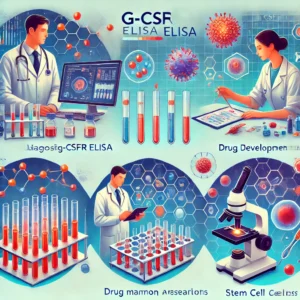
The G-CSFR ELISA Kit is a versatile tool for studying hematopoietic regulation and cytokine receptor biology. It is widely used in:
- Signal Transduction Studies: Monitoring downstream signaling pathways activated by G-CSF binding (National Cancer Institute).
- Mutation Analysis: Investigating the effects of G-CSFR mutations on cell proliferation and apoptosis (ClinicalTrials.gov).
- Stem Cell Research: Evaluating the role of G-CSFR in stem cell mobilization for transplantation (Stem Cell Information).
2. Diagnostics
Quantifying G-CSFR levels is crucial in diagnosing and managing hematological conditions. The G-CSFR ELISA Kit provides accurate results for:
- Monitoring neutrophil recovery in chemotherapy patients (CDC Chemotherapy Guidelines).
- Identifying CSF3R mutations in genetic screening programs (Genetic Testing Registry).
3. Therapeutic Development
Pharmaceutical research benefits from using G-CSFR ELISA in evaluating G-CSF analogs like filgrastim and pegfilgrastim, which are widely used to treat neutropenia. Learn more about these therapeutics on the FDA Drug Database.
Technical Features of the G-CSFR ELISA Kit
- High Sensitivity: Detects G-CSFR concentrations as low as 10 pg/mL, making it ideal for low-abundance cytokines (NIST Standards).
- Specificity: Validated to avoid cross-reactivity with related cytokines like GM-CSF or IL-3 (NIH Reagent Guide).
- Reproducibility: Intra- and inter-assay coefficients of variation (CVs) are consistently below 10%, ensuring reliable results (FDA Clinical Guidelines).
Workflow: How the G-CSFR ELISA Works
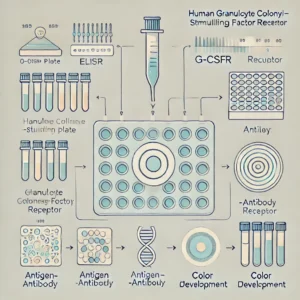
The assay employs a sandwich ELISA format for precise quantification:
- Capture: A monoclonal antibody specific to G-CSFR binds the antigen in the sample.
- Detection: A biotin-conjugated secondary antibody enhances sensitivity.
- Signal Amplification: Streptavidin-HRP binds to biotin, catalyzing a colorimetric reaction measurable at 450 nm (CDC Assay Development Guidelines).
Visit NIH Assay Tutorials for detailed protocols.
Clinical Relevance of G-CSFR Quantification
1. Hematological Disorders
- G-CSFR quantification helps differentiate between idiopathic neutropenia and cyclic neutropenia. For clinical insights, see MedlinePlus.
- Assessing G-CSFR mutations is crucial in CNL and AML diagnosis, as highlighted by the American Society of Hematology.
2. Cancer Research
Aberrant G-CSFR expression in tumors underscores its potential as a biomarker for treatment response. Read more about its role in oncology at Cancer Research UK.
3. Therapeutic Monitoring
Quantitative ELISA assists in evaluating patient response to G-CSF therapies, optimizing treatment regimens (Health.gov).

Advantages of G-CSFR ELISA in Research and Clinical Use
- Ease of Use: Ready-to-use reagents streamline the workflow, saving time and resources (FDA Methodology).
- Comprehensive Validation: Rigorous testing ensures the kit meets international standards for research and diagnostics (CDC Quality Assurance).
- Wide Applicability: Suitable for use in academic, clinical, and pharmaceutical research (NIH Research Resources).
Where to Learn More?
- Explore cytokine-receptor interactions at PubMed Central.
- Review G-CSFR gene mutations and their clinical implications at the Genetics Home Reference.
- For assay guidelines and standards, consult NIST.
The Human Granulocyte Colony-Stimulating Factor Receptor (G-CSFR) ELISA Kit is an invaluable tool for advancing our understanding of hematopoietic processes and improving diagnostic and therapeutic approaches for immune-related disorders. To explore purchase options or request technical support, visit the official product page on FDA-registered platforms.